DIGITAL QUEUE MANAGEMET SYSYEM:
In the modern service economy, the most expensive resource is no longer real estate or inventory—it is time. For businesses ranging from healthcare clinics and government departments to retail banks and telecommunications hubs, the “physical line” has become a symbol of operational failure. The traditional model of standing shoulder-to-shoulder in a crowded lobby is being systematically replaced by sophisticated Digital Queue Management System (QMS).
A modern Digital Queue Management System is far more than a digital version of a paper ticket dispenser. It is a complex engine of data, logic, and real-time communication designed to orchestrate the movement of people through a service journey. Below, we explore the essential features and the underlying IT logic that make these systems indispensable for any organization looking to optimize its “human traffic.”
OMNI-CHANNEL VIRTUAL ENTRY: Digital queue management system
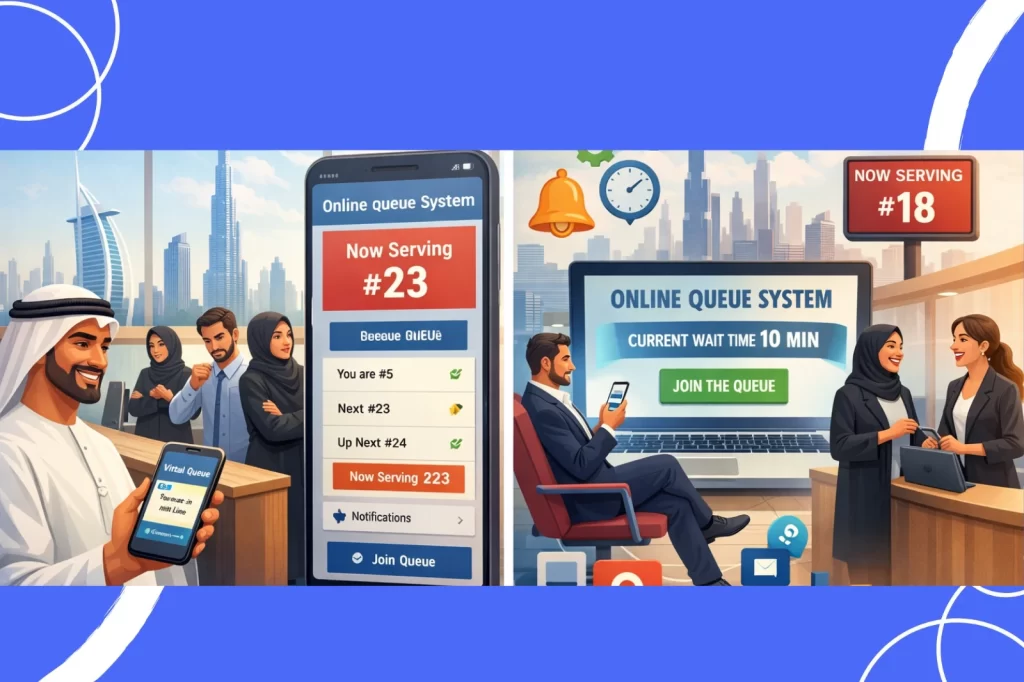
The first goal of a modern Digital Queue Management System is to decouple the “queue” from the physical “waiting room.” A digital system enables customers to join the line digitally via various digital “front doors” even before entering the physical space.
- QR Code Integration:Once customers arrive at the space, they use a QR code placed at the front door. This code enables customers to access a mobile browser, allowing customers to join the line immediately without having to download an app.
- Remote Web Check-in: Customers can join the queue remotely from their home or office by accessing the organization’s website.
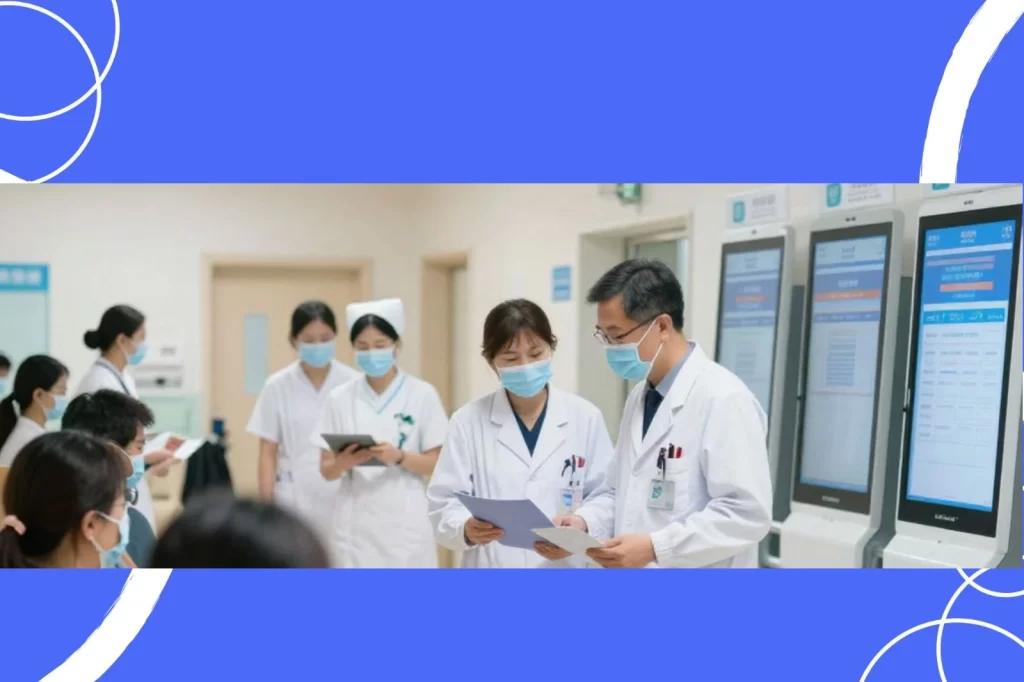
- Self-Service Kiosks: If you prefer to interact with a machine or don’t havea smartphone easy-to-use touchscreens are available. These screens connect directly to our database.
INTELLIGENT TRIAGE AND ROUTING LOGIC:
A basic line follows “First-In, First-Out” (FIFO) logic. While fair in a simple grocery store, this is highly inefficient in complex service environments. A modern system uses Segmented Routing:
- Service Categorization: When a user joins, the system asks for the purpose of the visit (e.g., “Account Opening” vs. “General Inquiry”). The logic engine then places them in the correct virtual “bucket.”
- Skill-Based Routing: The IT backend identifies which staff members are logged in and what their specific expertise is. It routes the next customer to the agent best qualified to help them, reducing “internal transfers” and total service time.
- Priority Rules: Our system can be set up with rules that give priority to certain groups of people. For example we can prioritize people, people, with disabilities or those who have pre-booked appointments. This is done automatically without needing to reorganize the queue.
3. DYNAMIC WAIT-TIME ESTIMATION: in Digital queue management system
Psychological studies show that the primary cause of customer frustration is not the wait itself, but the uncertainty of the wait. Modern Digital Queue Management System solutions use Predictive Analytics to provide transparency.
- Live Throughput Calculation: The system constantly monitors how fast agents are currently clearing tickets.
- Historical Data Layering: It factors in time-of-day trends. For example, if the system “knows” that Monday mornings usually see a 20% spike in complexity for a specific service, it adjusts the estimate accordingly.
- The “Wait Anywhere” Benefit: By pushing an “Estimated Wait Time” (EWT) to the customer’s phone, the organization gives the customer back their freedom. They can wait in a nearby café or run other errands until their turn approaches.
REAL-TIME NOTIFICATIONS AND TWO-WAY COMMUNICATION:
Communication is the “glue” of a virtual queue. Because the customer isn’t standing in front of the counter, the system must act as a digital usher:
- SMS and Push Alerts: Automated messages keep the customer engaged. Typical triggers include “You have joined the line,” “There are 3 people ahead of you,” and the final “Please proceed to Counter 4.”
- Status Links: Customers receive a persistent URL where they can watch their position in the queue move in real-time.
- Snooze/Delay Logic: Advanced systems allow customers to reply to a text to “Delay” their turn by a few minutes. This prevents them from losing their spot entirely if they are momentarily tied up.
CENTRALISED STAFF PERFORMANCE DASHBOARDS:
A digital Digital Queue Management System is a powerful tool for management. Every interaction—from the moment a ticket is issued to From the second a ticket gets issued to the moment someone marks the service as “Complete,” every step becomes a valuable data point.
- Service Level Agreement (SLA) Tracking: Managers can set up alerts if wait times get too long—say, over 15 minutes. That way, they know when to open more counters before the line gets out of hand.
- Average Handling Time (AHT: By keeping an eye on how long each service actually takes, managers spot where training needs to happen or which processes are just way too slow.
- Live Branch Monitoring: With a central dashboard, managers get a quick snapshot of what’s happening across all their branches. It’s easy to see which locations are slammed and which ones have room to spare.
DIGITAL SIGNAGE AND MULTI-SENSORY CALLING:
Inside the lobby, the system really needs to communicate clearly with people waiting.
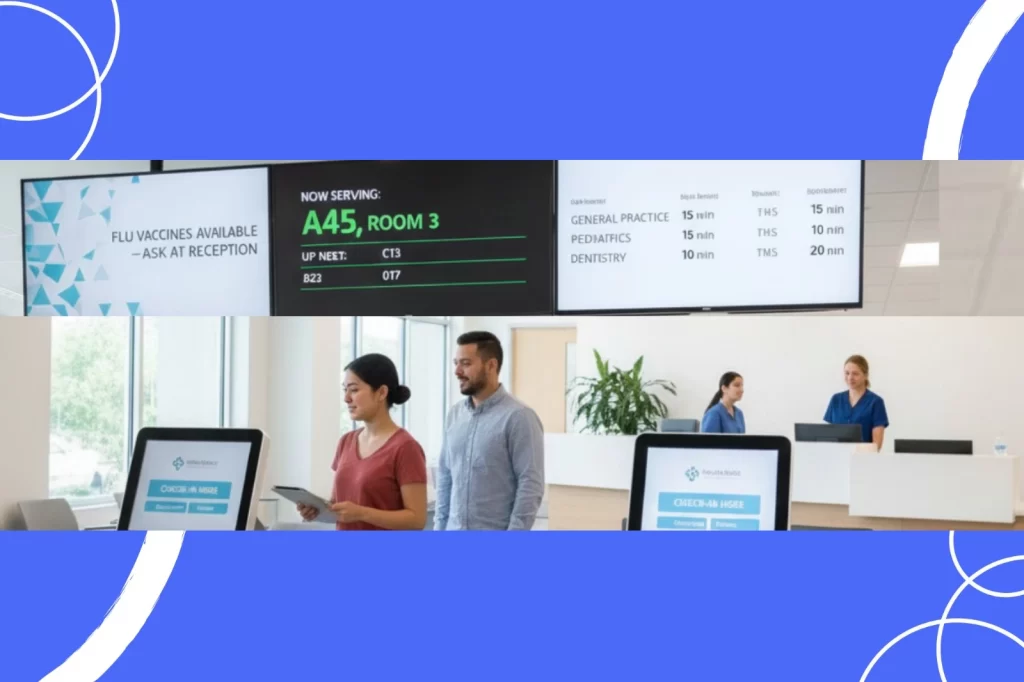
- Visual Displays: Bright, high-def screens display current ticket numbers and which service area people should head to.
- Audio Announcements: The system uses multilingual text-to-speech, so even if someone’s visually impaired or glued to their phone, they still know when it’s their turn.
- Infotainment Integration: These screens can show news, weather, or even ads. People feel like time moves faster when they’ve got something to watch, so a 10- minute wait feels a lot shorter.
POST-SERVICEFEEDBACK LOOPS:
The experience doesn’t just stop when the agent says “goodbye.” A good Digital Queue Management System keeps thing moving:
- Instant Surveys: As soon as a ticket closes, the system can send out a quick SMS – “ Rate your experience from 1 to 5.”
- Data Correlation: Managers can connect the dots between low ratings and things like long wait times or certain counters. That way , they actually know where to improve.
CLOUD ARCHITECTURE AND SECURITY:
From an IT perspective, the modern standard is a Cloud-Native or Hybrid deployment.
- Scalability: A cloud-based system allows a business to add new branches or counters in minutes without installing local servers.
- Centralized Control: A head office can monitor wait times across fifty different city branches from a single “Command Center” dashboard.
- Data Privacy: Essential security features ensure that customer phone numbers or identification details are encrypted and handled according to global data protection standards (like GDPR).
THE UNDERLAYING IT LOGIC: WHY THIS WORKS:
From a technical standpoint, a modern Digital Queue Management System is typically built on a Cloud-Native or Hybrid architecture. This allows for:
- Scalability: If an organization opens a new branch, the queuing logic can be deployed instantly without installing heavy local servers.
- Data Security: By using encrypted tokens instead of names, these systems can protect customer privacy while managing their flow.
- API Integration: A great Digital Queue Management System doesn’t live in a silo. It connects to the company’s CRM through APIs , so when a ticket comes in< but way more personal.
THE ROI OF EFFICIENCY:
Getting a Digital Queue Management System isn’t just about keeping up appearances. It really hits the bottom line.
- Lower operational costs : Staff work smarter because they always focus on the most important task at hand.
- Increased Sales: In retail environments, customers are more likely to browse and shop if they aren’t “tethered” to a physical line.
- Improved Employee Morale: Staff members are less stressed when they aren’t facing a visible, frustrated crowd standing directly in front of their desks.
Lorem ipsum dolor sit amet, consectetur adipiscing elit. Ut elit tellus, luctus nec ullamcorper mattis, pulvinar dapibus leo.