Online queue system
With this dynamic setting, businesses are forced to adjust to the new standards of safety. For businesses that offer essential services, the safety of customers and employees has become an issue. The use of an online queue system is one of the best approaches to maintain social distancing while still offering quality services.
What is an online queue system?
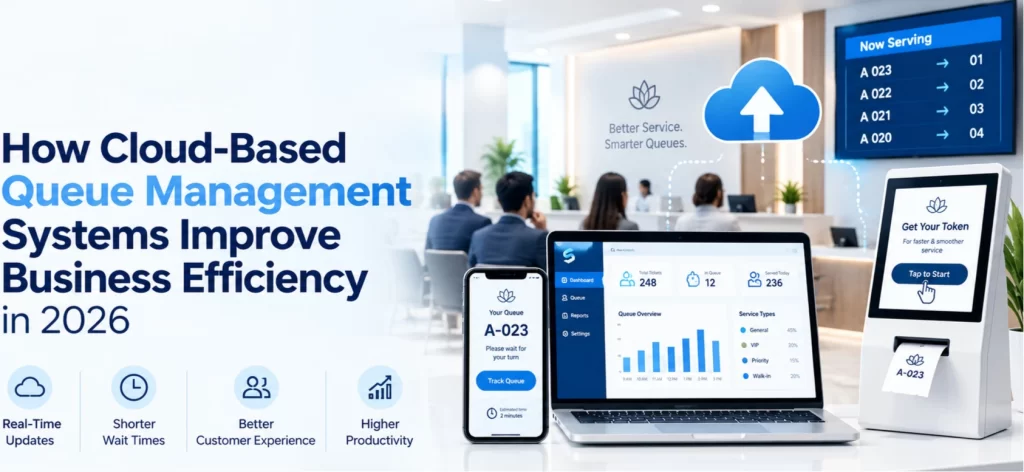
An online queue system can be perceived as a “virtual waiting room” that helps customers avoid waiting in a physical line. The online queue system enables visitors to reserve their place in the service delivery line from a distance, without having to be in a particular location during the waiting period.
How do visitors join?
A visitor’s spot is held by a digital identifier—usually a mobile ticket, an SMS notification, or an app—though printed tickets are still an option. While these are often issued upon arrival, many systems allow customers to join the queue in advance by booking an appointment. Because the system tracks their turn automatically, the traditional physical line becomes obsolete.
The Standard Online Queuing Workflow
To optimize flow and safety, the online queue system process typically follows these five stages:
- Entry Initiation:
The customer checks in by scanning a QR code posted at the facility’s exterior.
- Service Selection:
A virtual ticket is generated once the user selects their specific service through the mobile interface.
- Remote Monitoring:
The system provides real-time updates, which allow the customer to wait in a remote location (such as a car) while viewing their current location and estimated wait time.
- Staff Notification:
Using a mobile app, employees can see the queue and “call” the next customer when they are ready to assist.
- Socially Distanced Service:
This phased entry model ensures that the physical service area remains uncrowded and secure for both staff and visitors.
How does a online queue system support social distancing?
Online queue system allows for the entire customer process to take place in a digital realm, which results in a drastic reduction in the need for physical contact. This is due to the fact that, since the customers check in using their devices and wait in a remote location, a safe distance is maintained throughout the entire process.
Key safety advantages include:
- Capacity Control:
Precisely managing the volume of people on your property at any given time.
- Minimal Contact:
Cutting down on unnecessary close-range interactions.
- Rapid Visits:
Decreasing the total duration a customer needs to remain on-site.
- Organized Flow:
Creating a structured movement of people to prevent crowding.
What are the primary advantages of digital waiting lines?
A digital management system is an innovation that changes the waiting experience by significantly reducing waiting times and ensuring a smooth flow of all concerned. This system increases the productivity and performance of the team while maintaining effective communication. Moreover, it also records essential performance data and customer information, enabling organizations to improve their operations based on data analysis
Understanding the Mobile Ticket
Mobile Ticket: This is an electronic ticket that is sent to the visitor’s mobile device, thus eliminating the need for physical paper tickets. This technology allows the visitor to get real-time updates on their position in the queue. The customer is also given the liberty to wait anywhere they want, thus removing the walls of the waiting room.
Digitizing the Customer Experience
An online queue system allows several key stages of the visitor journey to move into the digital space.
Here is how the process is optimized:
- Pre-arrival:
Visitors can lock in their spot before leaving home by scheduling appointments via through a website or a simple phone call.
- Contactless Check-in:
Once they are there, customers can enter the virtual line by scanning a QR code or with the assistance of a staff member in a socially distanced manner.
- Off-site Waiting:
The system frees customers to wait in any safe location. They can check their real-time status in the queue using their devices and receive an automatic notification when it is their turn.
- Follow-up:
After the service is finished, businesses can send digital surveys to gather instant feedback.
Strategies for Maximizing Online Queue Efficiency
To help your organization adapt seamlessly to the dynamic demand, here are some high-impact optimization strategies that you can consider:
- Prioritize Scheduled Entry:
Optimize your appointment booking system to minimize unpredictable walk-in customers and ensure a smooth stream of customers on a daily basis.
- Implement Intelligent Segmentation:
Customers should be based on their unique needs or appointment types rather than relying on a “one-size-fits-all” approach.
- Data-Driven Staffing:
Leverage data to optimize staffing levels, ensuring that wait times are balanced and predictable.
- Transparent Communication:
Build trust by automatically sending reminders, queue status, and accurate wait tome estimates to the customer’s device.
- Operational Analytics:
Consistently track performance metrics to find areas for improment and optimize your service delivery model.
Industry Applications for Online Queuing
During periods of restricted movement, online queuing serves as a lifeline for essential service providers. It is particularly effective for:
- The Public Sector:
Assisting government agencies to continue operating while ensuring citizen safety.
- Healthcare:
Coordinating patient flow in hospitals and clinics to avoid crowded waiting areas..
- Essential Retail:
Allowing grocery stores and pharmacies to regulate store capacity.
Maximizing Retail Safety with Digital Queue Control
To comply with capacity limits, retailers can leverage online queue systems in two primary ways to protect both staff and shoppers:
- Virtual Entry Management:
For physical browsing, stores can implement a “wait-anywhere” model.
- Streamlined Curbside Pickup:
For “click and collect” orders, online queuing coordinates the hand-off process. When a customer arrives and turns on the digital link, the staff are immediately notified to come out with the order.
Conclusion:
With the easing of restrictions and the subsequent rise in foot traffic, the “rebound” effect will challenge the efficiency of every service provider. The online queue management system provides the infrastructure needed to handle this number without compromising safety and quality. By adopting these “wait anywhere” solutions today, UAE businesses can make sure they are ready to compete in the next chapter of the digital customer experience.