Digital Queue Management Solution
Stand in a bank lobby for ten minutes. Watch the faces. Nobody’s happy. Nobody’s ever happy waiting for a number to be called, and honestly, that one small frustration is the whole reason a Digital Queue Management Solution has become such a talked-about tool across clinics, banks, government centers, and retail outlets in the UAE. At Simple Logic IT, we get some version of this question almost every week, usually from a business owner who’s just started shopping around: does a Digital Queue Management Solution only manage people who show up on the day, or can it also handle bookings made in advance? Good question. Not a simple one, though.
What a Digital Queue Management Solution Manages Right Now
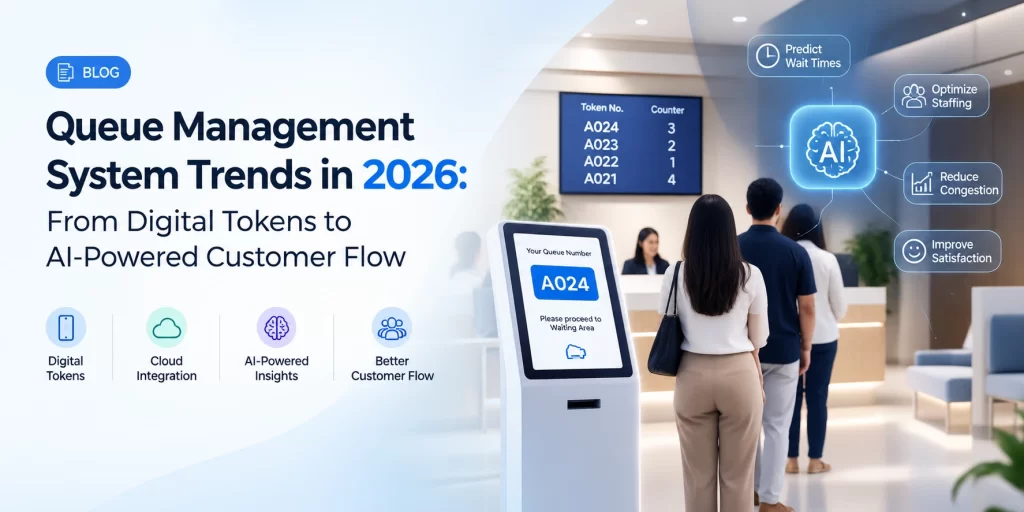
Here’s the honest answer. Most of what’s commonly deployed today, a Digital Queue Management Solution is built around the walk-in crowd first and everything else second. Someone walks in, grabs a digital token from a kiosk or scans a QR code, and their spot in line gets tracked electronically instead of scribbled on a clipboard. That’s the job, and most systems do it well. Staff can see the headcount, the average wait, which counter’s lagging behind. Customers get a screen or a text telling them roughly when they’re up, so they can wander off, grab a coffee, stop hovering by the counter like it owes them something.
None of this is surprising, is it? Think about which industries picked up a Digital Queue Management Solution first — banks, telecom outlets, government service counters. These are places where people rarely call ahead. You don’t book an appointment to renew a driving licence. You just show up and hope the line’s short. So it makes sense that early systems were built to handle that unpredictable, on-the-spot rush rather than a calendar full of future bookings.
Why Reservations Got Left Behind
While managing the waiting list and managing future queues may have similar surface characteristics, these processes are actually fundamentally different problems. A walk-in queue only has to answer one question: who’s next, right now? A reservation system has to answer something trickier: who’s arriving in two days, at what exact time, and how do we keep that slot from colliding with everyone else’s plans? Building a Digital Queue Management Solution that handles both, properly, takes a lot more than bolting a calendar widget onto a token machine. And that’s more or less why, even now, a lot of these products treat reservations like an afterthought. If booking exists at all, it’s often just a form sitting off to the side, completely disconnected from whatever’s happening on the actual floor.
We’ve watched this gap trip up plenty of businesses. Picture a salon. A client books a 3pm haircut. Fine. But at 2:45, someone else walks in wanting a quick beard trim, no appointment, no warning Most Digital Queue Management Solution setups? They’re not great at blending those two realities into one smooth, intelligent line.
Where This Is All Heading
But it’s changing. It has to. The next wave of a Digital Queue Management Solution is being designed with reservations baked in from day one, not bolted on afterward. Instead of running two separate systems side by side — one for bookings, one for the live queue — future platforms will merge both into a single flow. Wait estimates adjust automatically as pre-booked customers show up alongside walk-ins.
Picture this: a patient books a 10am slot through an app. A Digital Queue Management Solution recognizes that booking, holds the slot, and quietly slots walk-in patients in around it — no receptionist juggling two separate lists in her head. If the 10am patient runs five minutes late? The system reshuffles on its own instead of leaving the next person standing there confused. That’s where the industry is heading, and it’s honestly one of the more exciting shifts we’ve watched unfold, because it solves a problem people actually deal with, rather than adding some feature nobody asked for.
What This Means If You’re Choosing a System Today
If you’re evaluating a Digital Queue Management Solution right now, ask the vendor directly: where does reservation support sit on your roadmap? Some platforms already offer basic hybrid features, letting you take bookings alongside walk-ins, even if the two don’t talk to each other perfectly yet. Others are purely walk-in, which is fine, genuinely, if your business never takes appointments in the first place. But if you’re running a clinic, a salon, a wellness centre, anywhere customers like to book ahead, don’t settle for something that pretends reservations don’t exist.
Think about where your business is headed too, not just where it is now. A business that’s walk-in only today might want appointment booking next year. Pick a system with room to grow into that, and you’ll save yourself the headache of ripping everything out and starting over later.
So, Where Does That Leave Us?
Does a Digital Queue Management Solution offer future reservations, or is it stuck handling walk-in waitlists only? Right now, walk-in handling is what’s widely available and genuinely reliable, while reservation support is still playing catch-up across most of the market. That’s shifting, though, and shifting fast. The systems that manage to combine both will end up defining what this technology looks like a few years from now. At Simple Logic IT, that’s exactly the direction we’re building toward — because a queue shouldn’t really care whether someone booked ahead or just walked in off the street. It should just work. For everyone standing in that line.